
Rock True Triaxial (Polyaxial)
GCTS offers a variety of equipment to perform true triaxial (polyaxial) tests on prismatic specimens.
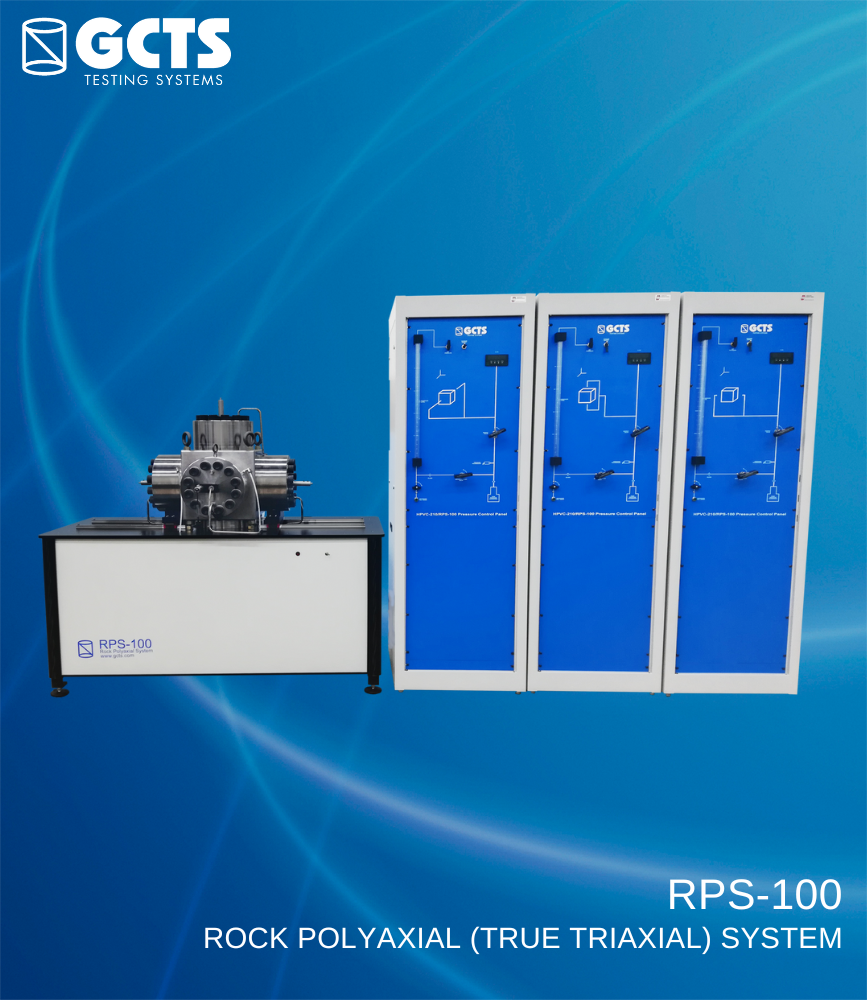
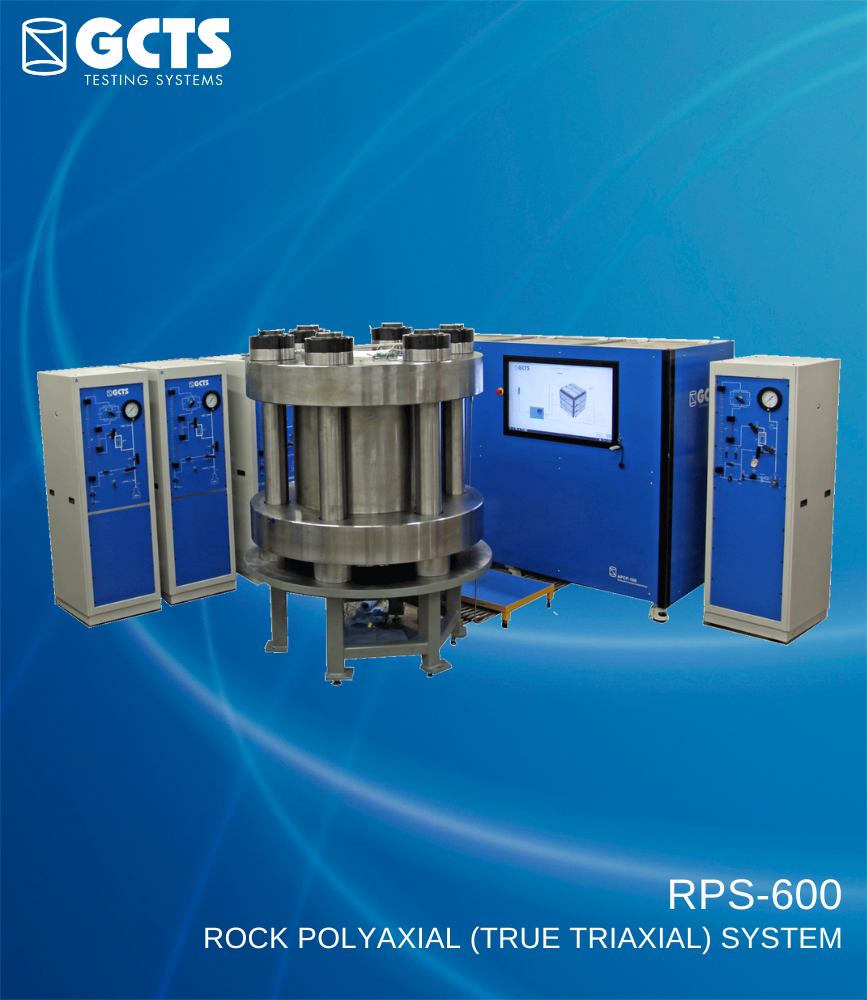
The RPS-100 and RPS-600 True Triaxial Testing Systems provide complete solutions for true triaxial testing. These systems can be used to study the intermediate principal stress effect on rock engineering behavior and adequately describe the strength of a rock under a general system of polyaxial compressive stresses. They are designed to apply three independent stresses (σ₁, σ₂ and σ₃) onto a cubical test specimen by utilizing hydraulic intensifiers to apply pressure to solid platens that are in direct contact with the specimen. Both systems can be upgraded with pore pressure control, temperature control, and ultrasonic velocity sensors for P and S wave measurements. In addition, both systems can be upgraded with hydraulic fracturing platens to approximate the effects of anisotropic stress state on borehole stability. The RPS-100 is designed for cubical specimens with sides up to 100 mm and the RPS-600 is designed for cubical specimens with sides up to 300 mm (with an upgrade available for specimens up to 600 mm tall).

RPS-100
The GCTS RPS-100 Small-Scale True Triaxial (Polyaxial) Rock Testing System is a versatile, servo-controlled system engineered for advanced polyaxial material characterization of rock specimens in modern laboratories. Designed for cubical specimens up to 100 mm per side, it enables independent control of the three principal stresses (σ₁, σ₂, σ₃) to study the effects of intermediate principal stress on rock behavior under true triaxial conditions. Its closed-loop servo control and high-resolution data acquisition ensure exceptional accuracy and repeatability for a wide range of geomechanical testing applications.
Features:
- Independent control of σ₁, σ₂, and σ₃ (where σ₁ ≠ σ₂ ≠ σ₃) or ε₁, ε₂, ε₃, or a combination of stress and strain control on each axis
- Closed-loop servo control with independent axis management
- Measures strains in all three orthogonal directions
- Maximum major principal stress of 210 MPa
- Direct contact solid platens with hydraulic intensifiers for uniform stress application
- Options:
- Ultrasonic sensors for P- and S-wave velocity measurements
- Temperature control up to 150 °C
Specimen and Load Specifications:
- Max. Specimen Size: Cubical specimens with sides up to 100 mm (4 x 4 x 4 in)
- Maximum Major Principal Stress: 140 MPa
Requirements:
- Suitable laboratory environment with adequate space and load-bearing capacity for the system
- Electrical supply in accordance with installed hydraulic intensifiers and controller (consult GCTS for site-specific requirements)
Dimensions:
- Weight: 771.1 kg (1,700 lbs.) not including the hydraulic pump or cabinets
- Size: 475 x 150 x 180 cm (178 x 59 x 70 in) includes cabinets, but not hydraulic pump
RPS-200
The GCTS RPS-200 Medium-Scale True Triaxial (Polyaxial) Rock Testing System is a versatile, servo-controlled system engineered for advanced polyaxial material characterization of rock specimens in modern laboratories. Designed for cubical specimens up to 200 mm per side, it provides independent control of the three principal stresses to investigate rock strength and behavior under complex true triaxial stress states. Its closed-loop servo control and high-resolution data acquisition ensure exceptional accuracy and repeatability across diverse geomechanical testing applications.
Features:
- Independent control of σ₁, σ₂, and σ₃ (where σ₁ ≠ σ₂ ≠ σ₃) or ε₁, ε₂, ε₃, or a combination of stress and strain control on each axis
- Closed-loop servo control with independent axis management
- Measures strains in all three orthogonal directions
- Direct contact solid platens with hydraulic intensifiers for uniform stress application
- Options:
- Pore pressure control up to 100 MPa
- Ultrasonic sensors for P- and S-wave velocity measurements
- Hydraulic fracturing platens for wellbore stability testing
- Temperature control up to 300 °C (572 °F)
Specimen and Load Specifications
- Max. Specimen Size: Cubical specimens with sides up to 200 mm (8 in × 8 in × 8 in)
- Maximum Major Principal Stress: 100 MPa
Requirements:
- Suitable laboratory environment with adequate space and load-bearing capacity for the system
- Electrical supply in accordance with installed hydraulic intensifiers and controller (consult GCTS for site-specific requirements)
Dimensions:
- Weight: 3,850 kg (8,500 lbs.) not including the hydraulic pump or cabinets
- Size: Ø102 cm (40 in) x 160 cm (63 in) does not include cabinets or hydraulic pump
RPS-600
The GCTS RPS-600 Large-Scale True Triaxial (Polyaxial) Rock Testing System is a versatile, servo-controlled system engineered for advanced polyaxial material characterization of large rock specimens in modern laboratories. Designed for cubical specimens up to 300 mm per side (with optional upgrade for taller specimens), it applies independent orthogonal stresses in all three principal directions using multiple hydraulic cylinders and intensifiers. This enables comprehensive study of rock behavior under true triaxial conditions, including optional hydraulic fracturing and acoustic emission monitoring. Its closed-loop servo control and high-resolution data acquisition ensure exceptional accuracy and repeatability for large-scale geomechanical testing.
Features:
- Independent control of σ₁, σ₂, and σ₃ (where σ₁ ≠ σ₂ ≠ σ₃) or ε₁, ε₂, ε₃, or a combination of stress and strain control on each axis
- Closed-loop servo control with independent axis management
- Measures strains in all three orthogonal directions
- Maximum major principal stress of 100 MPa (15,000 psi)
- Six actuator blocks with multiple hydraulic cylinders per face for uniform stress distribution
- Confining pressure capability with oil as confining medium
- Options:
- Pore pressure control
- Ultrasonic sensors for P- and S-wave velocity measurements on principal planes
- Acoustic emission monitoring with 3D event location
- Hydraulic fracturing platens for wellbore stability testing
- Temperature control up to 200 °C
- Gradient stress control and specimen size upgrades
Specimen and Load Specifications:
- Max. Specimen Size: Cubical specimens with sides up to 300 mm (12 in × 12 in × 12 in); upgrade available for taller specimens
- Maximum Major Principal Stress: 100 MPa (15,000 psi)
- Actuator Configuration: 6 actuator blocks (9 hydraulic cylinders each, total 54–56 cylinders) with servo-controlled intensifiers
Requirements:
- Suitable laboratory environment with substantial floor space and load-bearing capacity for the large-scale assembly
- Electrical supply in accordance with the hydraulic intensifiers, heaters (if equipped), and digital controller (consult GCTS for detailed site-specific power requirements)
Dimensions:
- Weight: 11,350 kg (25,000 lbs.) not including the hydraulic pump or cabinets
- Size: Ø159 cm (62.5 in) x 213 cm (84 in) does not include cabinets or hydraulic pump